


☀️Watt's up with plug-in solar?
In early April, the Maine Legislature passed LD1730, An Act to Make Small Plug-In Solar Generation Devices Accessible for All Maine Residents to Address the Energy Affordability Crisis. Since then, plug-in solar has generated a lot of buzz across the state, but folks still have questions. What exactly is plug-in solar? Does it make sense for me? Can I get it right now? Is it truly DIY? This blog post helps answer those questions and provides an overview of plug-in solar, Plug-In Solar 101, if you will. It will give you the foundation you need to join the conversation and figure out what other questions you might have.
First things first, what is plug-in solar? Plug-in solar refers to small-scale solar systems that plug into a standard household outlet. This lets you add solar power to a property without installing a full rooftop array. These systems are also called “plug-and-play” because, once plugged in, they don't need additional setup or configuration. While this technology is new to the United States, other countries, such as Germany, have already adopted it successfully.
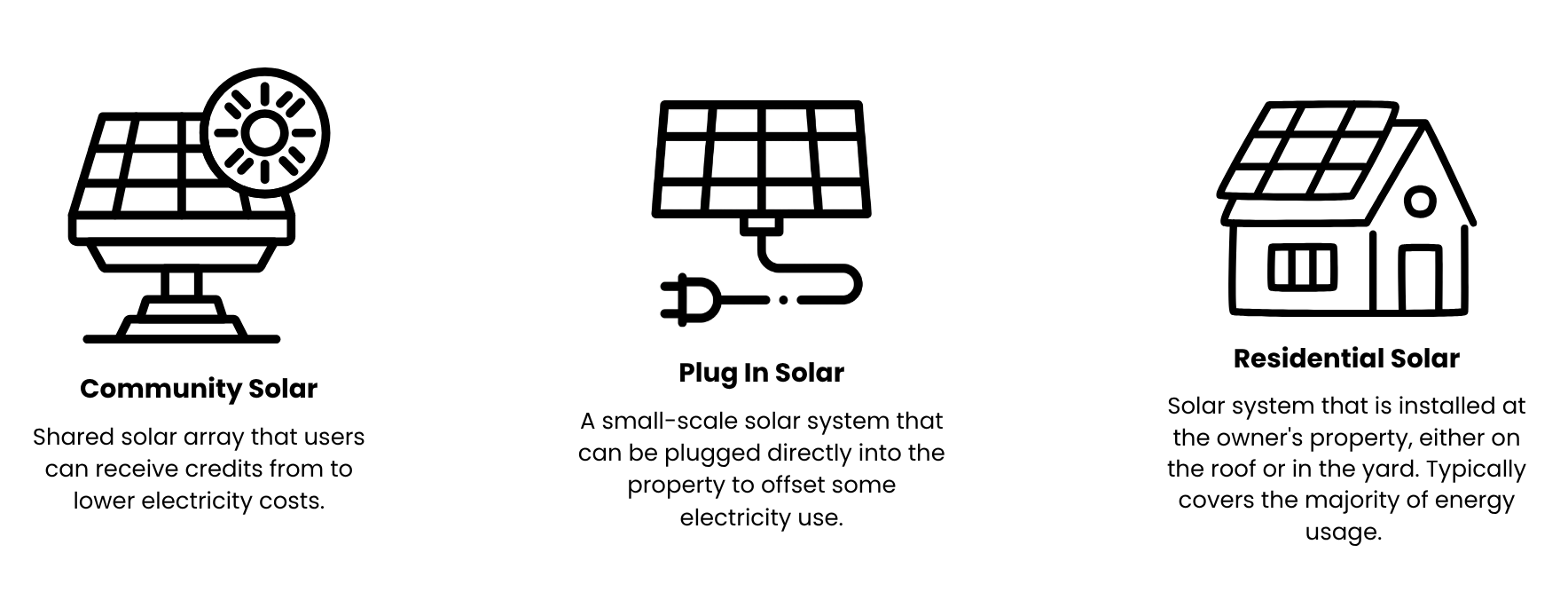
How does it differ from other forms of solar energy? When you consider other forms of solar energy, you can think of plug-in solar as sitting between community solar and residential solar. With community solar, you don’t install any panels on your property; they are installed elsewhere. You then subscribe to the community solar project and purchase energy directly from the solar farm instead of another supplier. (A little confused about what “another supplier” refers to? Check out our How to Read Your Electric Bill page) The electricity generated by the solar panels you subscribe to is then credited to your electric bill, reducing your cost. At the other end of the spectrum is residential solar, where you install panels on your property or directly on your roof. One important note: unlike community solar and residential solar, plug-in solar cannot cover most or all of your energy consumption. Instead, it offsets some of your electricity use and helps lower costs.
Does it make sense for me? Plug-in solar is a good option to offset some of your energy usage and therefore lower your monthly electricity bills. It can also be a great option for renters if your landlord and property allow for it. However, it is important to stress that it is not a replacement for installing a full solar array at your home. That means it cannot meet your home's full energy needs.
Can I get it right now? While the legislation that paved the way for plug-in solar passed in April, systems still needed certification to meet safety standards. Since then, two companies, Hoylines and AP Systems, have had their systems receive the necessary certifications.
Is it truly DIY? The best answer comes from Richy at the Center for an Ecology Based Economy (CEBE). He says, ‘[w]hile these systems seem to technically comply with the Maine legislation, they are far from DIY for the average household, as they require confusing and conflicting changes to household wiring that are beyond the expertise of most homeowners; likely requiring an electrician.
This shows there is still work to do to make plug-in systems easily accessible. However, the work is underway, and the Navigator team will share information as it becomes available. Organizations such as Climate to Thrive, the Center for an Ecology Based Economy, and the Natural Resources Council of Maine offer additional information, and we encourage you to explore the resources available from all those organizations. And if you have more questions, don’t hesitate to reach out to an Energy Navigator!
Comments